Know exactly
what you're looking at.
The clinical reference that turns "something's off with this client" into a session you can actually reason through. Corrective thinking, in the language you already teach in.
Built by a Polestar-certified instructor · grounded in the clinical literature · re-expressed in Floletics' own language
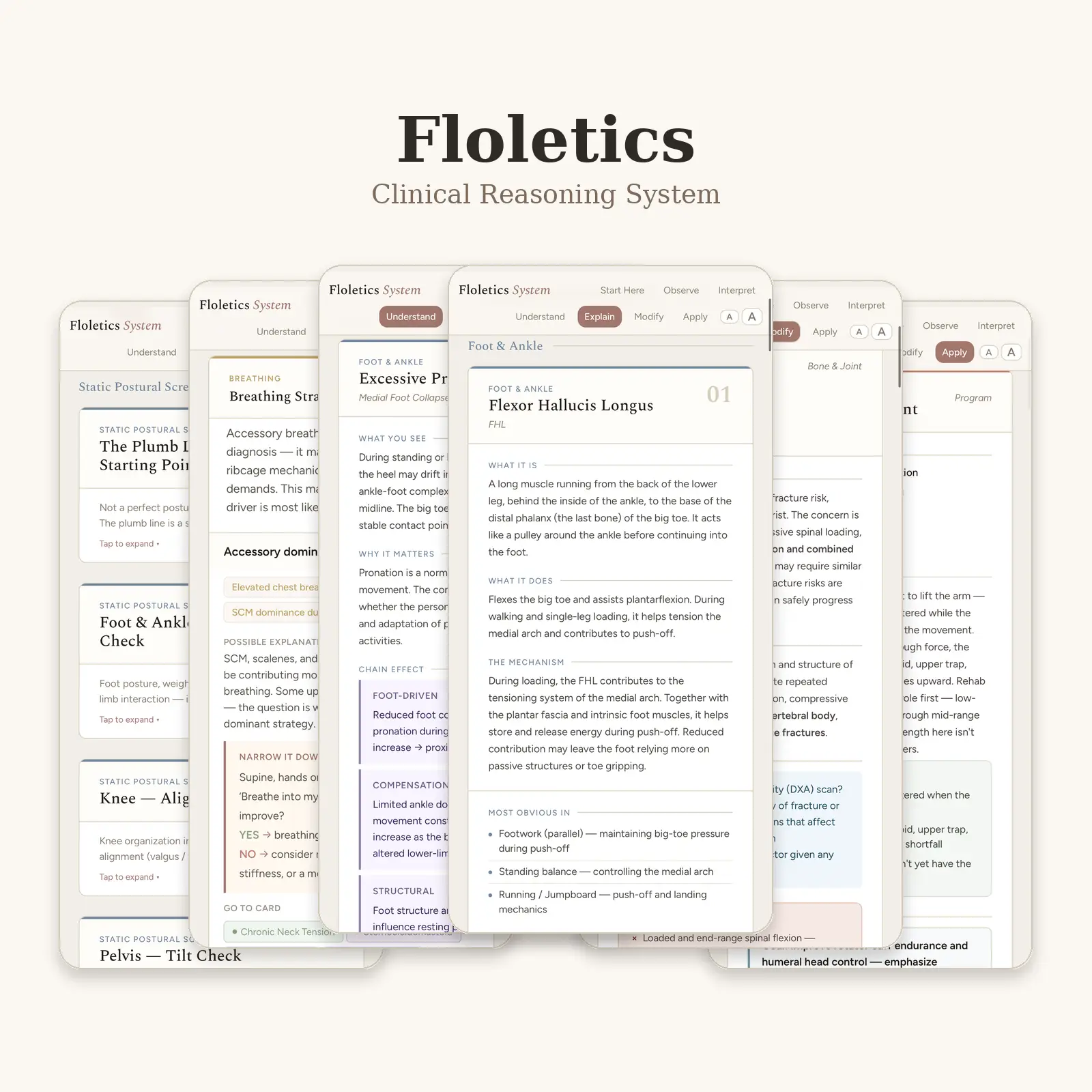
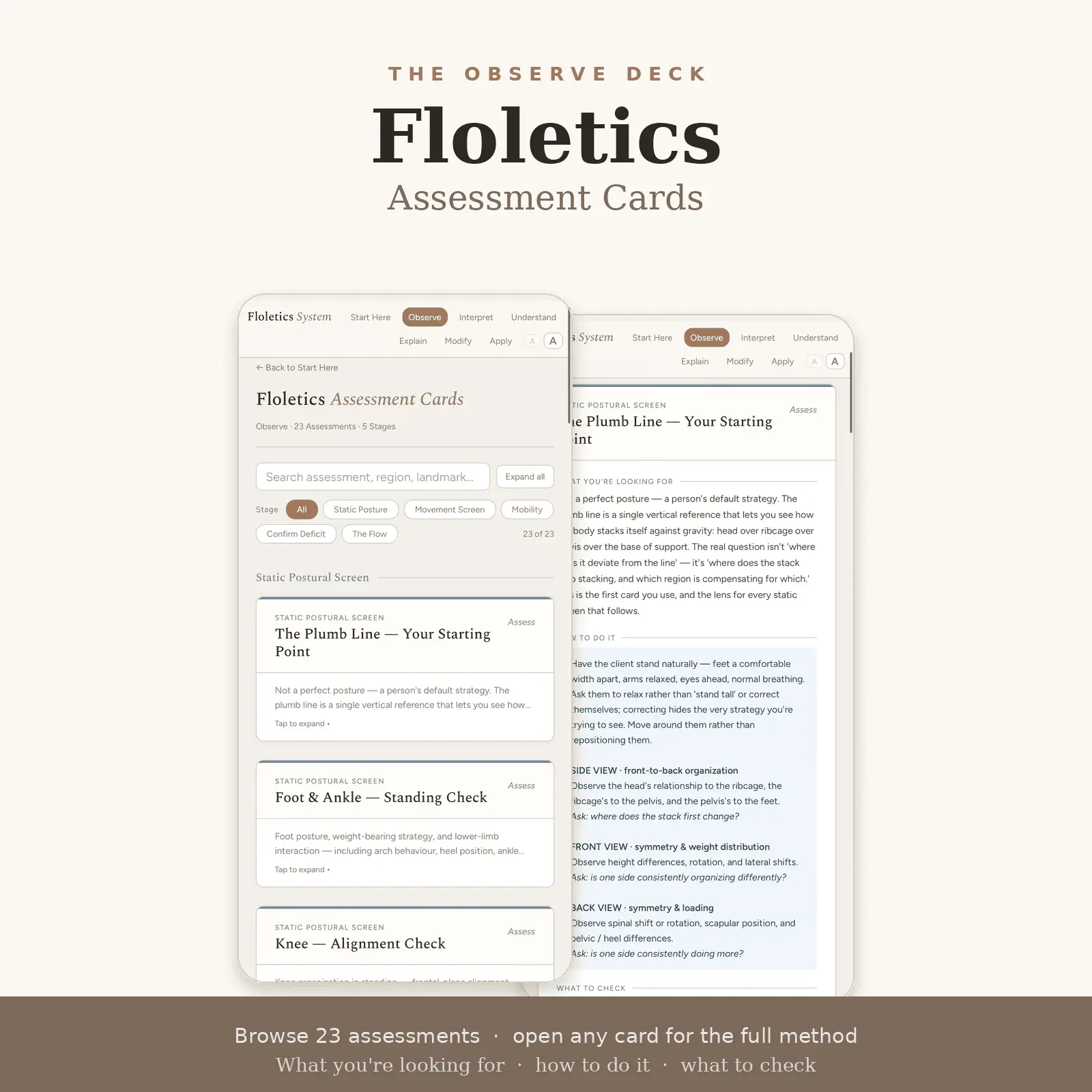
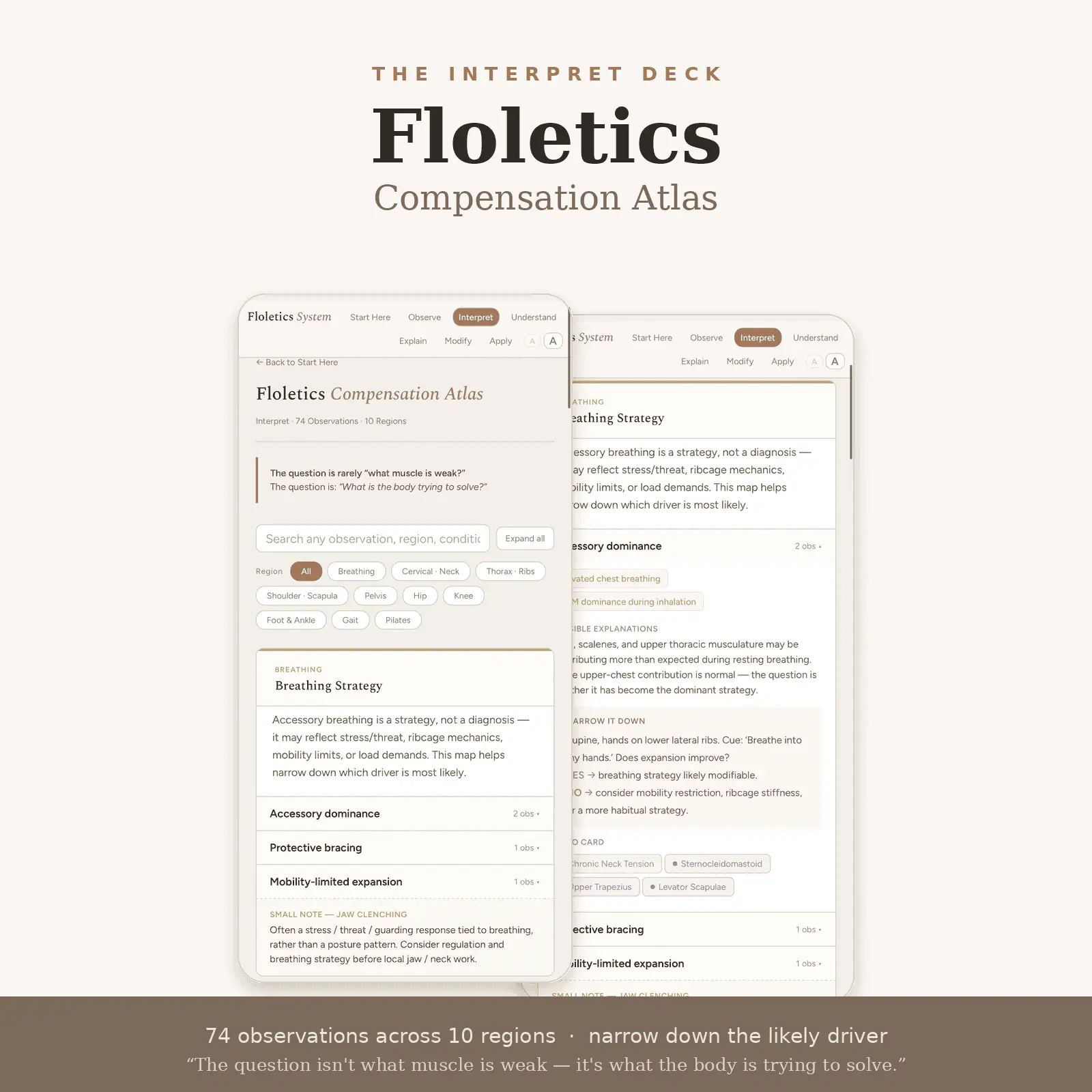
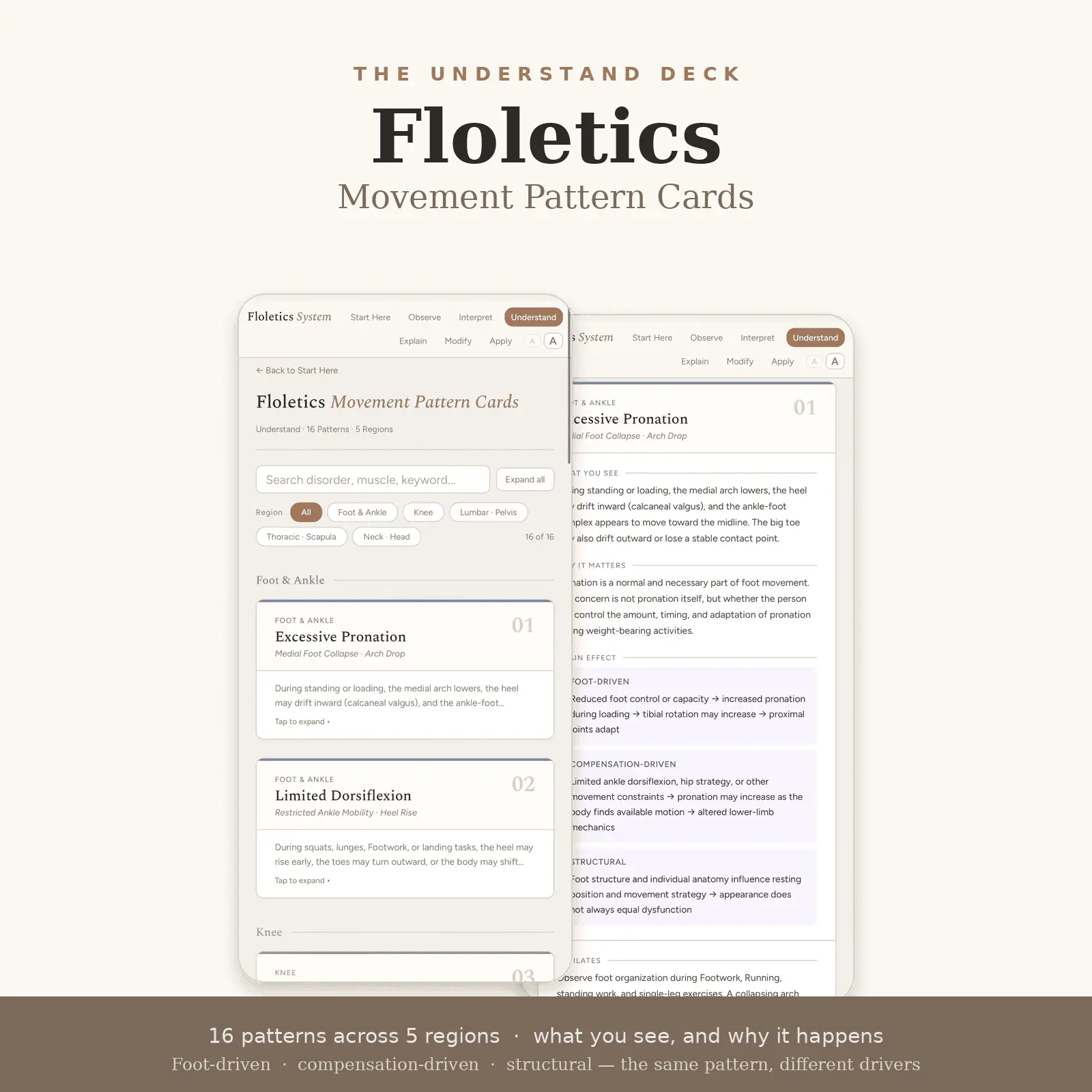
Six decks that talk to each other
Every card links to the next. You follow a client from the first thing you notice to the session you build — and you can start anywhere, because the trail is always there.
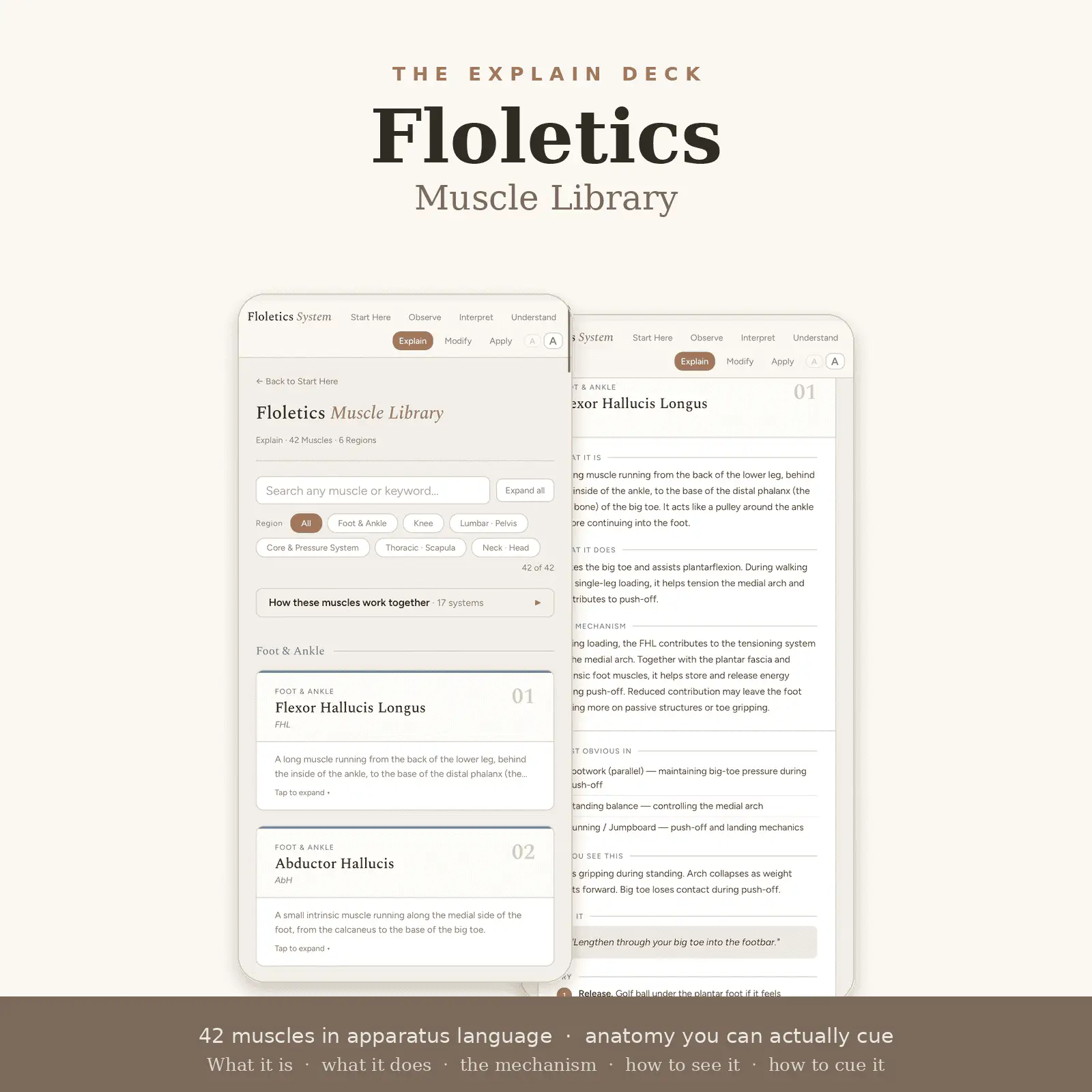
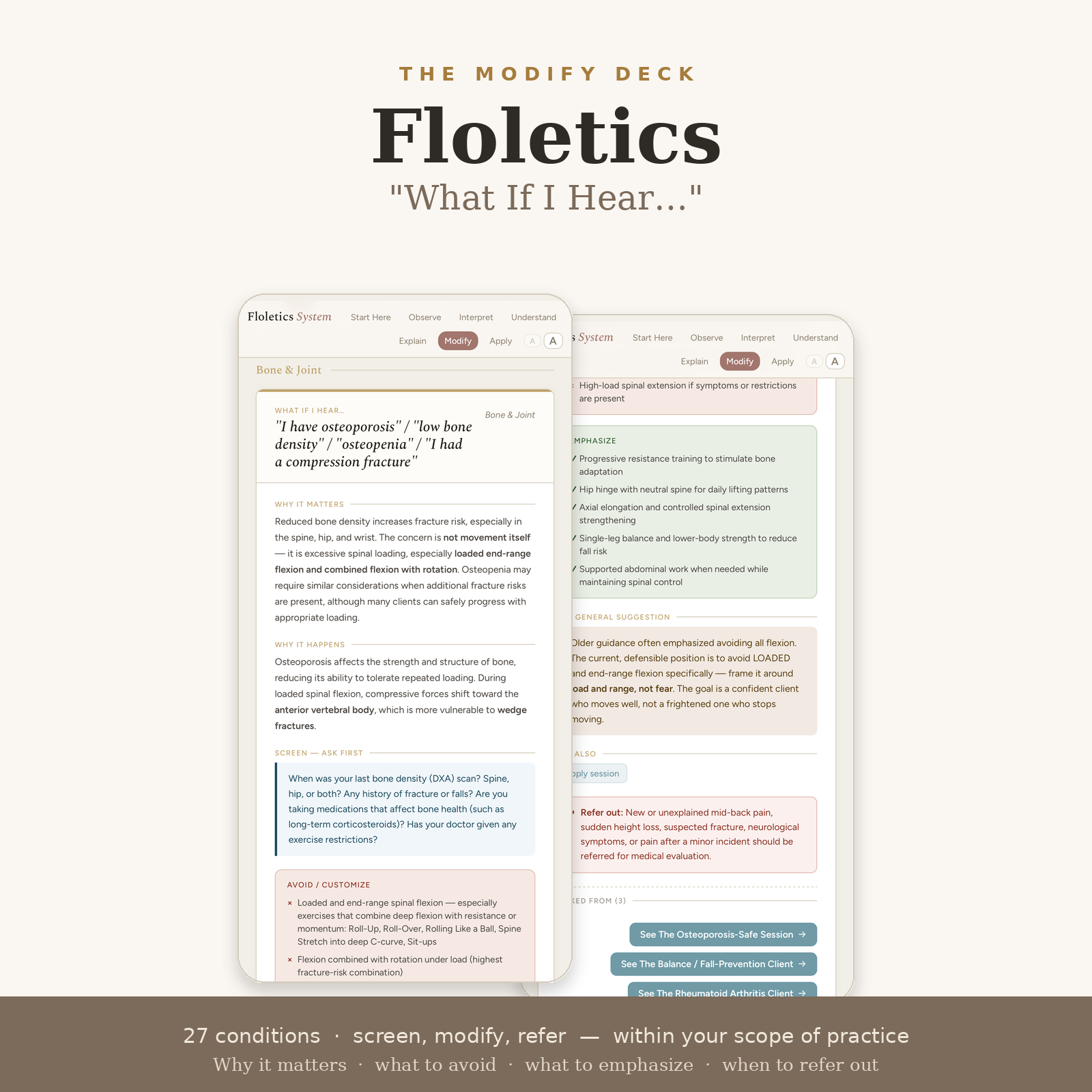
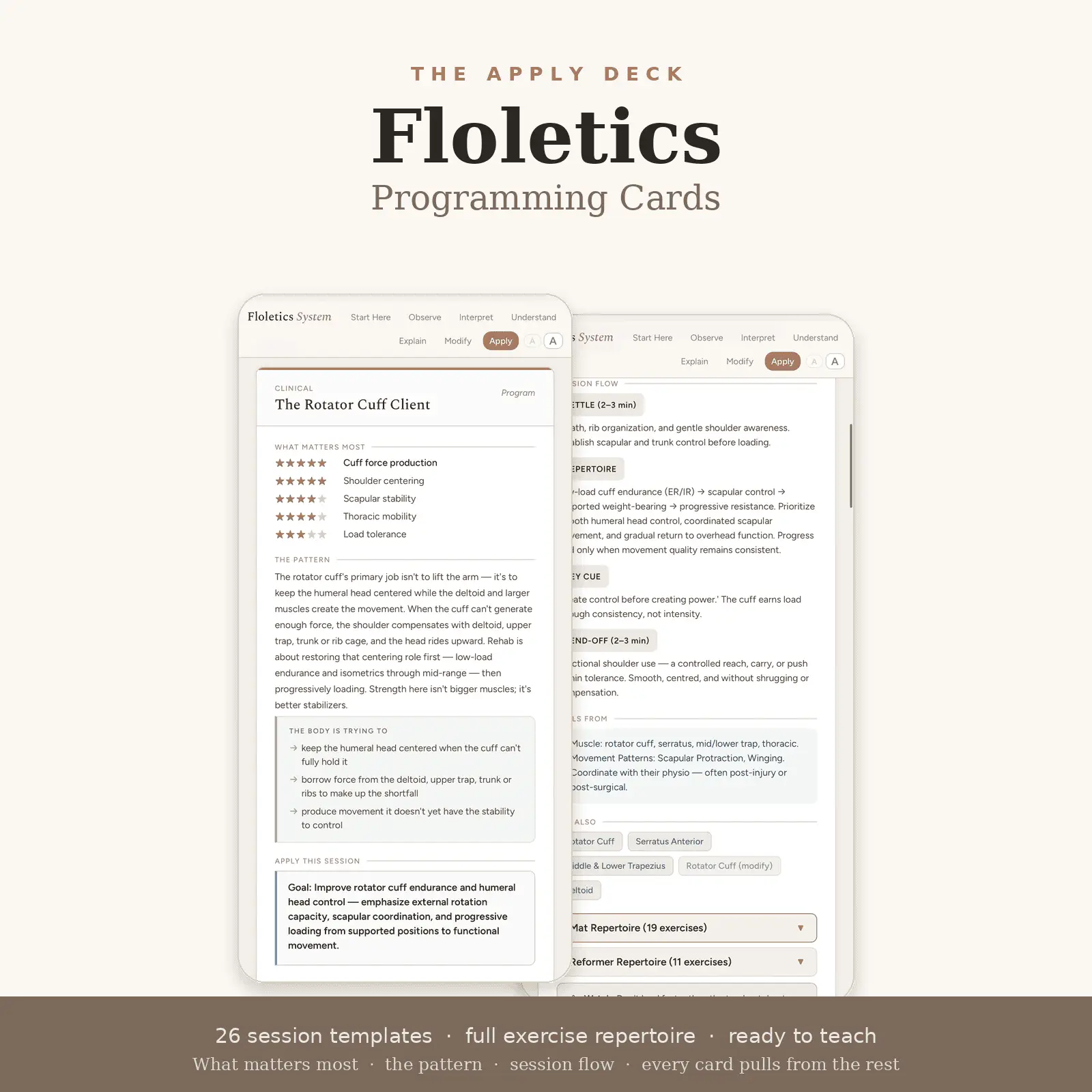
All six decks — one connected system
The missing bridge
You can find beautiful anatomy books and dense clinical texts. What's often missing is the piece in between — how to turn knowledge into a session you can actually teach.
Clinical knowledge
Anatomy, conditions, assessments, and red flags.
Floletics
The reasoning layer that connects what you see → what you consider → what you do.
Pilates practice
The exercises, cues, and modifications you already teach.
Deep enough to lean on
Not a cheat sheet. A searchable, cross-linked library you can reason inside of.
Every card connects to the next step — from condition → movement pattern → possible contributors → session strategy. Search what your client says and follow the path.
How you'll actually reach for it
Look it up, right now
Your client mentions something mid-class. Search it, understand what to screen, what to modify, and what to avoid — before the next exercise.
Build a reasoned session
Start from what you observed and follow the trail to a session built around what matters most for that client.
Fill the clinical gap
Browse any deck to build the clinical fluency your certification didn't — until reading a body starts to feel obvious.
Built by an instructor who lives on both sides
Floletics is built by a Pilates instructor with training in corrective exercise and rehabilitation principles. Every resource is built from education, current literature, and real teaching experience — using evidence-informed, load- and range-based language while clearly defining scope and when referral to a healthcare professional may be appropriate.
Created by Stephanie Lam, Polestar Comprehensive Certified Pilates Instructor (NCPT), with training in corrective exercise and pre/postnatal movement.
Grounded in the literature
Kinesiology & assessment — Neumann · Magee · Kendall · Jane Johnson
Movement patterns — Sahrmann · Janda
Clinical populations — Sherri Betz (bone health) · Sarah Ellis Duvall (pre/postnatal) · Beth Kaplanek (hip & knee) · Gwen Miller
Corrective exercise — NASM CES
If you've ever frozen for a second
The moment a client asks something you weren't taught how to answer — that's who this is for.
Newly-qualified instructors
You have the repertoire. Now build the clinical reasoning layer your certification couldn't cover.
Experienced instructors
You've taught for years, but certain clients still make you pause. Develop a clearer framework for what you see and what you do next.
Studios & teaching teams
A shared reasoning language, so every teacher screens, modifies, and refers with the same framework.
- Six interconnected decks — 200+ clinical reference cards
- Search by symptom, condition, muscle, or client type
- Works across phone, tablet, and laptop
- Screening considerations, modifications, and referral guidance
- New cards added as the system grows
Good things to ask
Is this medical advice?
No. Floletics Clinical System is an educational reference designed to support movement professionals' clinical reasoning within their scope of practice — not diagnosis or treatment. Condition cards include screening considerations and referral guidance to help you recognize when a situation is beyond general programming.
Is this a certification or continuing education course?
No. This is a reference system designed to support your teaching practice. It does not replace professional certification, clinical training, or scope-of-practice requirements.
Do I need a clinical or rehab background?
No. Floletics Clinical System was built for Pilates instructors who want to develop stronger clinical reasoning without needing a physiotherapy degree. It translates corrective-exercise concepts into the movement language you already teach.
How is Floletics Clinical System different from an anatomy book?
Anatomy tells you what structures exist. Floletics connects anatomy, movement patterns, client presentations, screening considerations, and programming decisions — so you can move from knowing the body to reasoning through a session.
What format is it, and what devices does it work on?
Floletics Clinical System is an interactive clinical reference you open in your browser — on your phone, tablet, or laptop. Searchable, cross-linked, and designed to be used while planning or teaching.
How do I access it after I buy?
Right after checkout you'll receive a private link to open your Clinical System. It lives in your browser — nothing to download or install. You can also add it to your home screen so it opens full-screen, like an app. The link is yours, and it always opens the latest version.
Can I use it on more than one device?
Yes. The same link works on your phone, tablet, and laptop — open it wherever you're planning or teaching.
Is it a one-time payment or a subscription?
One payment, ongoing access — including updates as the system grows. No recurring fees.
Does it get updated?
Yes — it's actively maintained, and your access includes updates. New conditions, movement patterns, and educational cards will be added over time.
Where does the clinical content come from?
Floletics Clinical System draws from contemporary movement science, corrective exercise education, Pilates education, and clinical literature — including frameworks from NASM, Polestar Pilates, Sahrmann, Neumann, Kendall, Betz, and others. All content is interpreted and rewritten in Floletics' own educational framework and language.
Can I get a refund?
Because Floletics Clinical System is a digital product with instant access, purchases are generally final. If you experience a technical issue or the product is significantly different from what was described, contact support@floletics.com and we'll help resolve it.