Floletics · Pilates Education Series
The Three Ways a Muscle Contracts
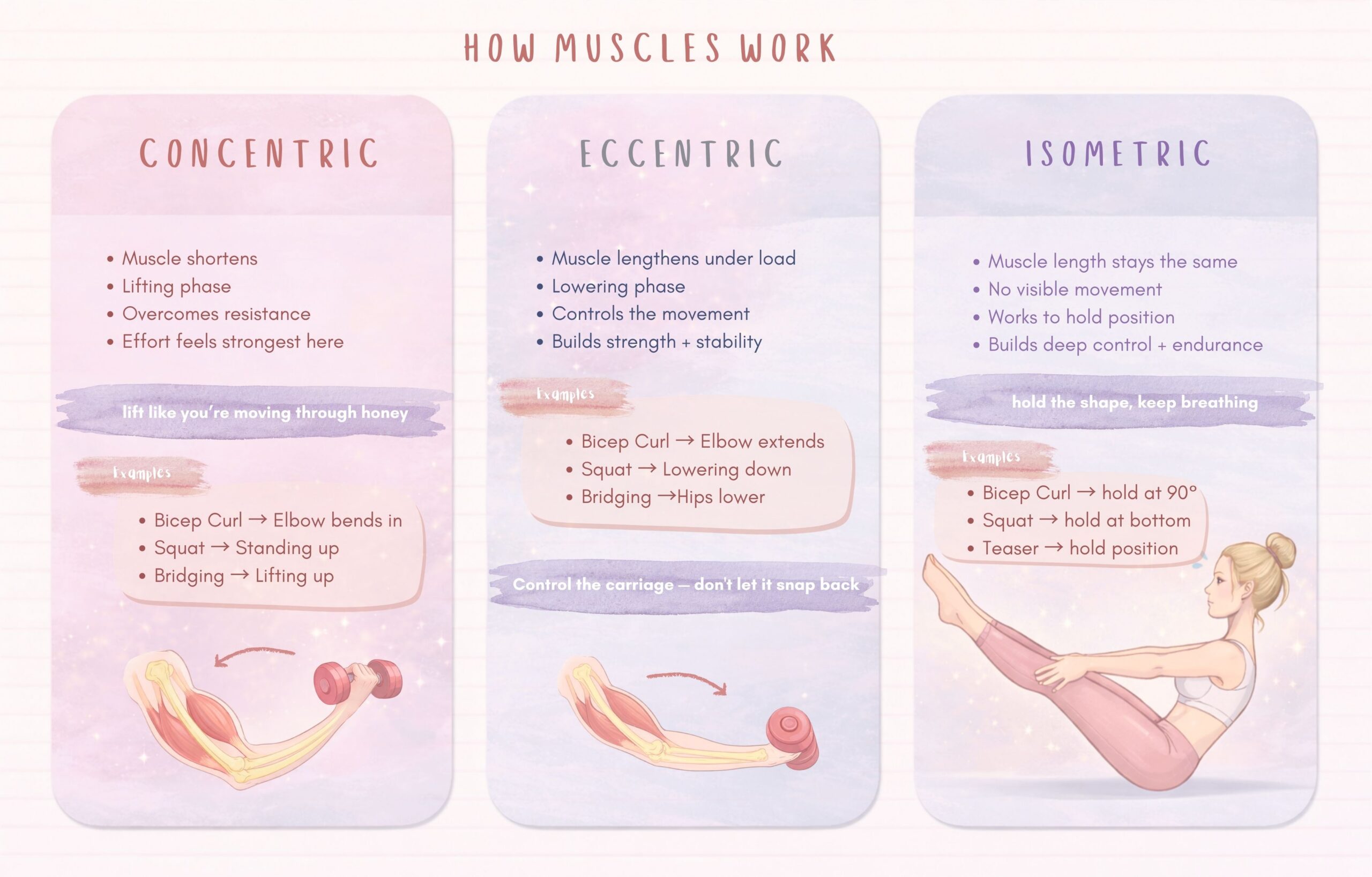
A muscle’s only active action is to produce tension. It can shorten, lengthen under control, or stay the same length — depending on the situation.
Contraction does not always look the same. There are three distinct types, and understanding them changes how you approach every single exercise.
1. Concentric Contraction — The Lift
In a concentric contraction, the muscle shortens as it generates force. The two attachment points move closer together. This is the classic “work” phase — the curl in a bicep curl, the standing-up phase of a squat, the pressing-out phase of reformer footwork.
2. Eccentric Contraction — The Control
In an eccentric contraction, the muscle generates force while being lengthened by an external load — gravity, the spring, body weight. The two attachment points move further apart, but the muscle is actively resisting that separation.
The slow lowering of a dumbbell. The rolling-down in a Bridge. The return of the carriage in the Stomach Massage. These are all eccentric contractions.
The Most Important Contraction Type
Eccentric work often creates high mechanical tension, making it extremely effective for strength, control, and tissue adaptation. In Pilates, this is why “controlling the return” is not just good technique — it is where a significant proportion of the training effect lives.
3. Isometric Contraction — The Hold
In an isometric contraction, the muscle generates force but does not change length. The force produced exactly balances the external load. Nothing moves. The Teaser hold. The plank. The pause at the top of a Bridge.
Isometric work is more effective for strength than concentric work but less effective than eccentric work. It is especially valuable for building endurance, joint stability, and body awareness — all cornerstones of Pilates.
The Training Ratio
A ratio of 1:2:4 tempo can be used as a training strategy — one count for the concentric phase, two counts for the isometric hold, four counts for the eccentric return. Applied to a reformer exercise: press out in 1 count, hold for 2, return in 4. The slow eccentric return is the most productive part of the repetition.
Pilates Application
This is why “control the carriage — don’t let it snap back” is one of the most important cues in reformer work. The return phase is not a rest. It is where the eccentric work happens, and it deserves the same conscious attention as the press.
How Muscles Work Together
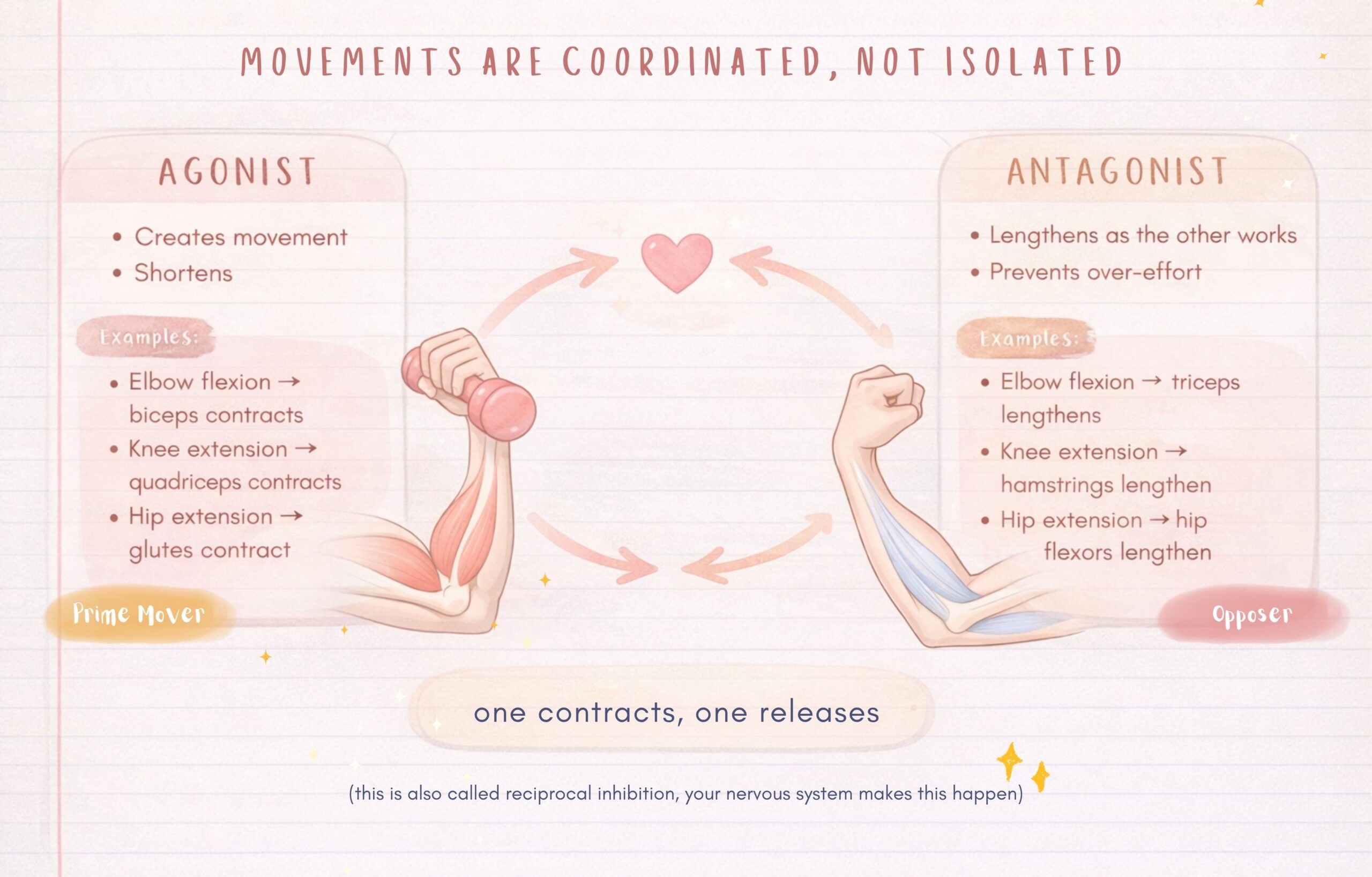
No muscle works in isolation. Every movement involves a coordinated system of muscles playing different roles simultaneously. Understanding these roles transforms how you analyse movement — your own and your clients’.
The Four Roles
- Agonist (Prime Mover) The muscle primarily responsible for producing the movement. The gluteus maximus in hip extension. The quadriceps in knee extension. The biceps brachii in elbow flexion.
- Antagonist (Opposer) The muscle that opposes the prime mover. The hamstrings are the antagonist to the quadriceps, and vice versa. Antagonists must actively lengthen (or at minimum, not resist) to allow movement to occur. They also control movement speed and prevent joints from being driven past their safe range.
- Synergist (Assistant) Muscles that assist the prime mover. During hip extension, the hamstrings and erector spinae are synergists to the gluteus maximus. They do not lead — they support.
- Stabiliser Muscles that hold segments still so other muscles can work effectively. The deep abdominals and multifidus stabilising the spine during leg work. The rotator cuff stabilising the humeral head during arm movements. Without effective stabilisers, prime movers cannot function safely or efficiently.
Reciprocal Inhibition & Why You Compensate
This is where anatomy meets real life — and where Pilates becomes genuinely rehabilitative rather than just a workout.
Reciprocal Inhibition
When a muscle contracts, its antagonist is simultaneously inhibited by the nervous system. This is reciprocal inhibition — a neurological mechanism that prevents muscles from “fighting each other” and wasting energy.
When your biceps contracts, your nervous system sends an inhibitory signal to the triceps. When your hip flexors contract, the gluteus maximus receives an inhibitory signal. This happens automatically, below the level of conscious awareness.
Why This Matters
Reciprocal inhibition is one of the core principles underlying Pilates training. When we talk about moving with ease, efficiency, and without unnecessary tension, we are describing a nervous system that has learned to inhibit what should not be working so that what should be working can work optimally.
Synergist Dominance — The Compensation Pattern
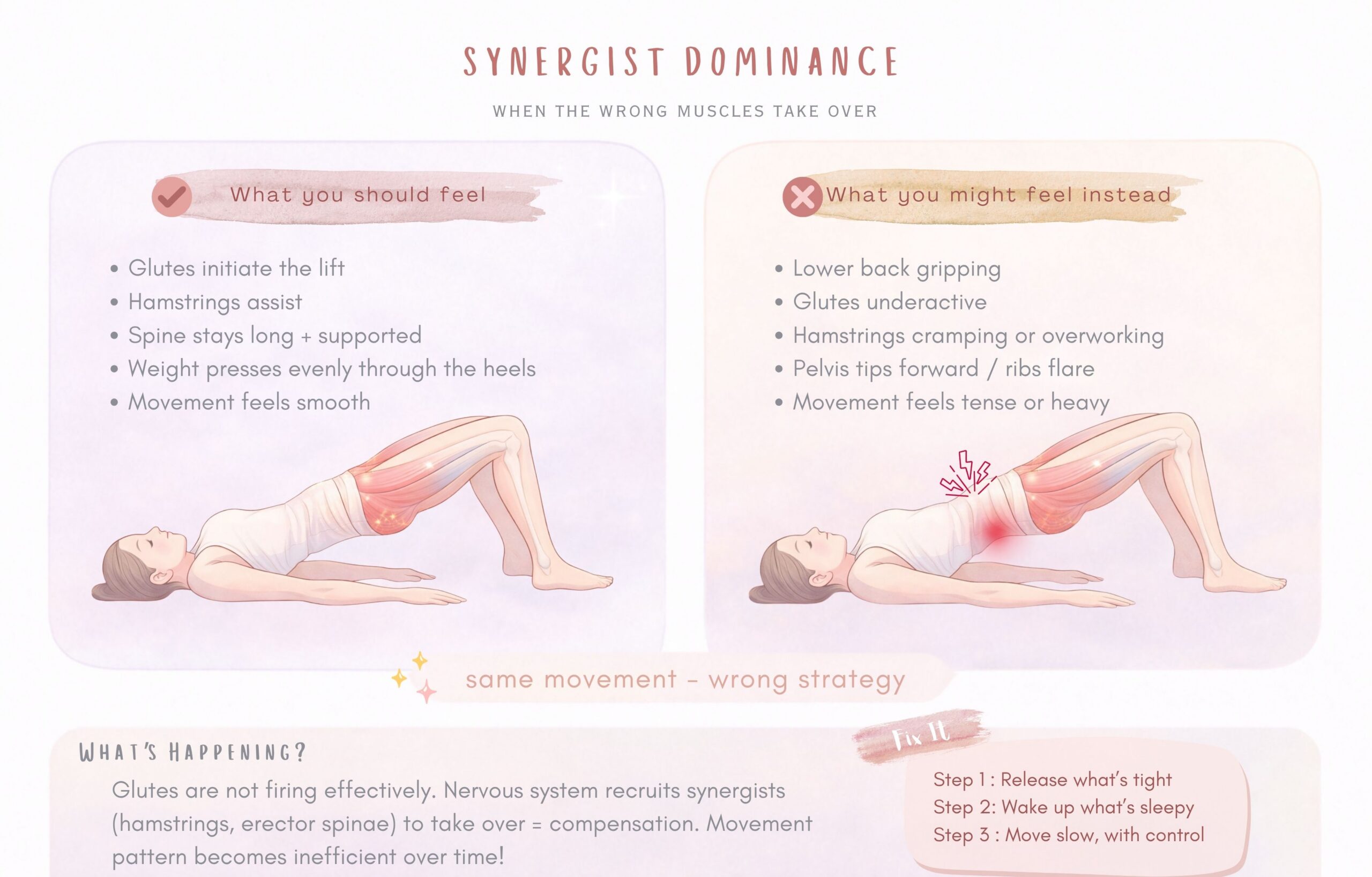
When a prime mover is inhibited, weakened, or not firing effectively, its synergists step in to compensate. The movement still happens — but the wrong muscles are doing the work.
The most clinically common example: when the gluteus maximus is inhibited (most commonly by prolonged sitting), the hamstrings and erector spinae compensate. The movement — hip extension — still occurs. But the load is now carried by muscles that were designed to assist, not lead. Over time, this creates overuse patterns in the compensating muscles and further inhibition of the prime mover.
If you feel your lower back working during a Bridge when it should be your glutes — this is synergist dominance in action.
The Compensation Chain
These patterns rarely occur in isolation. They unfold as a chain:
- Prolonged sitting → hip flexors (iliopsoas) shorten and become chronically tight
- Tight hip flexors → reciprocal inhibition of the gluteus maximus
- Inhibited gluteus maximus → hamstrings and erector spinae compensate
- Overworked erector spinae → low back pain
This is the mechanism behind the most common postural pattern in the modern world — and it is one of the primary things that intelligent Pilates training addresses.
The Three-Step Correction
Corrective training follows a logical sequence:
- Release the tight muscle — stretch the shortened hip flexors
- Activate the inhibited muscle — targeted glute activation (hip bridges, clamshells)
- Rebuild the movement pattern — integrated functional movements that reinforce the correct recruitment sequence